
Key points
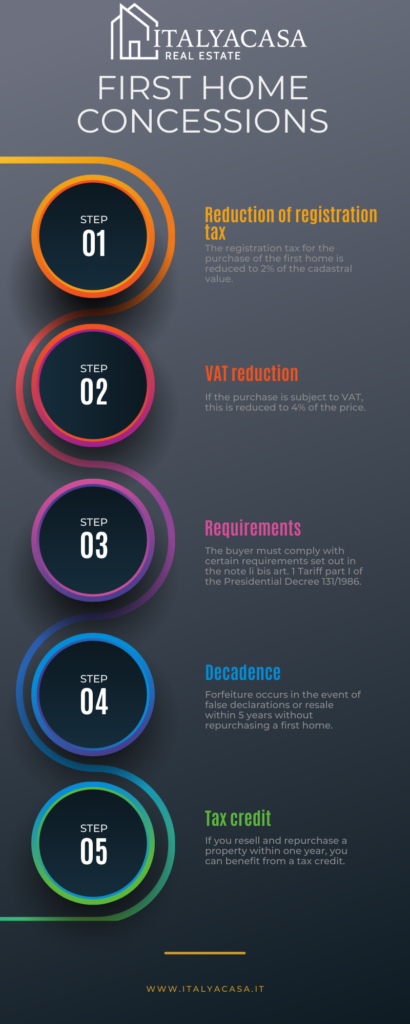
The first home tax relief entails a significant reduction in property transfer tax, decreasing from 9% to 2%, and VAT, reduced from 10% to 4%, for the purchase of the first residence.
The main causes of losing the first home tax relief include the submission of false statements during the purchase deed, selling the property within 5 years of purchase without subsequent purchase of another house within a year, and failure to transfer residence within 18 months.
The consequences of losing the tax benefits include the recovery of the difference between the reduced taxes paid and the ordinary taxes due, with a surcharge of 30%, in addition to the payment of late fees.
The tax credit for the purchase of the first home represents the difference between the property transfer tax paid for the new purchase and the tax paid for the sold property.
The tax relief for those under 36 allowed, until December 31, 2023, to purchase a property without having to pay property transfer, mortgage, and land registry taxes. However, this relief was not extended in 2024.
What tax benefits are available for purchasing the first home?
For those purchasing their first home to live in (which may include full or bare ownership, co-ownership, as well as real rights such as usufruct or habitation), the legislator has established a series of tax benefits. These benefits mainly consist of a reduction in property transfer tax, calculated at a rate of 2%, instead of the 9% rate applied to non-facilitated purchases.
In cases where the purchase is subject to VAT, the rate will be reduced to 4% instead of the 10% rate applied to non-facilitated purchases. Additionally, a fixed property transfer tax of 200 euros will be required.
Finally, if the purchase is made through a leasing contract, the rate for calculating the property transfer tax will be 1.5%, instead of 9%.
Applicability conditions: subjective and objective requirements
To be able to benefit from the first home tax relief concretely, the law establishes several requirements:
1. The object of the transfer must be a residential property that does not fall under cadastral categories A/1, A/8, and A/9, which include luxury homes, and naturally excludes category A/10 (offices).
2. The purchased house must be located in one of the following places:
– In the Municipality where the buyer already resides, or where they establish their residence within eighteen months from the date of purchase (this declaration must be included in the notarial deed, otherwise the right to the first home tax relief is lost);
– In the Municipality where the buyer works or studies.
3. In the purchase deed, the buyer must declare:
– Not to be the sole or married holder of property, usufruct, use, or habitation rights of another house in the Municipality where the purchased house is located;
– Not to be the owner, even in part, throughout the national territory, of property, usufruct, use, habitation, or bare ownership rights of another house purchased by the same buyer or by the spouse benefiting from the first home tax relief, or with those provided by law no. 168/1982 onwards.
Legislative Decree no. 69 of June 13, 2023, significantly amended the tax benefits for the first home for Italian citizens emigrated abroad. Before this amendment, an Italian citizen residing abroad could purchase a house in Italy benefiting from the first home tax relief without having to establish their residence in the Municipality where the property was located. However, this was not in compliance with the Treaty on European Union, as Italian citizens were not required to meet the residency requirement, thus being privileged. Article 2 of DL 69/2023 eliminated this possibility, significantly changing the situation of taxpayers transferred abroad for work reasons.
Currently, following this amendment, taxpayers transferred abroad, regardless of their nationality, can benefit from the first home tax relief if:
– They have resided or carried out their activity in Italy for at least 5 years;
– The property is located in the Municipality of birth or in the Municipality where they had their residence or carried out their activity before the transfer abroad.
Tax benefits for the purchase of ancillary properties
The law allows for tax benefits also for the purchase of ancillary properties, with the same benefits already mentioned, defined by the legislator as premises classified or classifiable in cadastral categories C/2 (cellar, storage, clearance room), C/6 (garage, box or parking space), C/7 (shed), intended to serve the residential property subject to the facilitated purchase.
It is important to note that to benefit from the first home tax relief in the purchase of ancillary properties, it is not necessary for these to be purchased in the same deed as the main house: the purchase of ancillary properties can enjoy the benefits even if done separately.
The requirements for the application of the first home tax relief in the purchase of ancillary properties are the same as previously listed, with the addition that the purchase of only one ancillary property for each aforementioned cadastral category is eligible.
Causes for forfeiture of the first home tax relief
Forfeiture of the first home tax relief, and thus of the previously described tax benefits, occurs in the following cases:
False declarations: forfeiture occurs whenever the statements made by the buyer in the purchase deed, mentioned above, are found to be false (for example, the buyer declaring to reside in the Municipality where the purchased property is located, without actual residence, or declaring to establish residence within the legal term without doing so).
Resale of the property within five years of purchase with tax benefits.
However, there is an exception to this last cause of forfeiture: the buyer does not forfeit the first home tax relief if, within one year of selling the property purchased with tax benefits, they proceed to purchase another property to be used as the main residence.
It is important to note that to avoid forfeiture, it is necessary to establish residency in the repurchased property, and that the purchase can also be made gratuitously (for example, through donation).
Another situation in which forfeiture does not occur is when the buyer, although already owning a property purchased with the first home tax relief, proceeds to purchase a new property requesting the same benefits.
Even if one already owns another property purchased with the first home tax relief, the law allows for the purchase of a new property benefiting from the tax relief, provided that the previous property is sold within one year of the purchase of the new property.
If the residence purchased with tax benefits is not sold within the legal term, forfeiture of the benefits obtained for the purchase occurs. This situation also applies if five years have not passed since the previous purchase, but in this case, to avoid forfeiture, in addition to selling the previous residence within one year of purchasing the new property, it is necessary to change residency to the new residence.
Consequences of forfeiture of the first home tax relief
Forfeiture of the first home tax relief entails the application of registration, mortgage, and cadastral taxes according to the ordinary rates, i.e., those provided for purchases without benefits, in addition to a surcharge of 30% on these taxes and the payment of late payment interest established by law.
In the case where the purchase deed is subject to registration tax, the competent Revenue Agency will recover the difference between the tax due and that actually paid (corresponding to the registration tax at 7%), in addition to imposing a penalty of 30% on the latter and requiring payment of legal interest.
Alternatively, in the case of a purchase subject to VAT, the competent Revenue Agency will recover the difference between the VAT paid and that due according to the ordinary rates (which equals VAT at 6%), along with imposing a penalty of 30% on this difference and requiring payment of legal interest.
Tax credit for the purchase of the first home
Whenever a first home is sold, and within one year of purchasing a new home also benefiting from the first home tax relief, one can avail themselves of the tax credit. This credit corresponds to the difference between the registration tax due for the purchase of the new property and the registration tax (or VAT) paid when the previously owned home was purchased with the first home tax relief.
The tax credit can be utilized in several ways:
- It can be deducted from the registration tax due for the purchase of the new property, up to the amount of the latter.
- It can be subtracted from the registration, mortgage, and cadastral taxes due on successions and donations related to deeds submitted after the acquisition of the credit.
- It can be used for offsetting, following Legislative Decree No. 241/97.
- Lastly, it can be used to reduce personal income taxes declared after the date of purchasing the new property.
The latter use is typically chosen by those who make a new purchase benefiting from an act subject to VAT. Since VAT does not allow for deductions, the tax credit will be used to reduce the income tax due for the tax period following the purchase.
It’s important to note that the tax credit can also be used if the buyer already owns a property purchased with the first home tax relief and purchases another property still benefiting from the same benefits, committing to sell the first property within one year of purchasing the second.
In any case, both the purchase of the new property and the sale of the old one must occur within one year of the sale of the first property or the purchase of the new one.
Under 36 Tax Benefits in 2024
With the enactment of the 2024 Budget Law, the tax benefits known as “Under 36” have not received further extensions. Consequently, starting from January 1, 2024, young first-time homebuyers can no longer benefit from this preferential regime, except as specified below.
We will explain below who was entitled to the under 36 first home bonus and how the benefits worked until December 31, 2023.
This involved the possibility, provided by the 2023 budget law, of purchasing a residential property without paying any registration, mortgage, or cadastral taxes.
The conditions for accessing this benefit were as follows:
Not having turned or turning 36 years old in the year of purchase.
Having an ISEE (Equivalent Economic Situation Indicator) not exceeding €40,000.00 annually, established according to the regulation of the Decree of the President of the Council of Ministers of December 5, 2013, No. 159.
Meeting the objective and subjective requirements necessary to access the first home benefit, listed previously in this guide.
In the case of an IVA (Value Added Tax) subject to purchase by a person who could access the so-called under 36 benefit, it was possible to deduct the entire VAT paid from the personal income tax, up to the amount of income tax owed.
In the event of forfeiture from the under 36 benefit (for example, if the ISEE exceeded the allowed threshold), the tax rules of the ordinary first home benefit applied.
Extension until December 31, 2024
Law No. 18/24, resulting from the conversion of decree-law No. 215/2023, effectively extended (until December 31, 2024) the so-called Under 36 benefits under the following conditions:
- Existence of a preliminary contract signed and registered by December 31, 2023.
- Applicant’s ISEE (Equivalent Economic Situation Indicator) below €40,000 annually.
For deeds executed between January 1, 2024, and the entry into force of the aforementioned law (February 29, 2024), if the above conditions are met, the buyer is entitled to a tax credit equal to the “excess paid” amount (see paragraphs 12-terdecies and 12-quaterdecies of the aforementioned conversion law).
Frequently Asked Questions
What are first home benefits?
First home benefits are tax incentives aimed at facilitating the purchase of properties intended to be the primary residence. These benefits include a reduction in the registration tax to 2% (instead of 9%) if the purchase is from a private individual, or of VAT to 4% (instead of 10%) if the purchase is made from a construction company.
How does the first home tax benefit work?
To qualify for tax incentives when purchasing a first home, the property must not be classified as luxury, meaning it should not fall under the cadastral categories A/1, A/8, and A/9. Additionally, the property must be situated in the municipality where the buyer resides or intends to establish their residence within 18 months of purchase, or in the municipality where they work. Moreover, the buyer must not own or hold other real rights to another property located in the same municipality or previously purchased with first home benefits anywhere in the national territory.
How does forfeiture of first home benefits work?
The primary reasons for forfeiture include:
- False declarations regarding not owning properties in the same municipality where one is making the purchase or properties previously acquired with first home benefits within the Italian territory.
- Selling the property within 5 years of purchase, unless another property is acquired to be used as the primary residence within one year.
- Failure to transfer residence to the municipality where the property is situated within 18 months of purchase.
- Failure to sell another property previously purchased with first home benefits within one year of purchasing the new property with the same benefits.
Can I buy a first home if I already own another property as my primary residence?
It is possible to purchase a new primary residence even if you already own one, under certain conditions. You must sell the previous property within one year of purchasing the new home to benefit from tax incentives. Additionally, the property must not be classified as luxury and must be located in the municipality where you intend to establish your residence.
When do the first home tax benefits end?
The first home tax benefits are a permanent measure under Italian legislation and do not have a defined expiration date.
For foreigners, the same rules apply as for a foreigner buying a house in general: if they can purchase the house, they can also benefit from the “first home” tax benefits.
In fact, Article 40 of Legislative Decree no. 286/98 establishes the so-called right of access to the first home (for more information, see “Buying a house”).
Foreigners who are legally residing in Italy and are registered with employment centers or engaged in subordinate or autonomous work activities have the right to access public residential housing and subsidized credit for housing, recovery, purchase, and rental of the first home, on equal terms with Italian citizens.
Another tax benefit related to the purchase of the “first home” concerns the deductibility (to a certain extent) from income tax of the interest paid on mortgages taken out for the purchase of the so-called first home.
Lastly, the income generated from the “first home” is not subject to income tax.
The legislator has established significant regulations in our legal system, which stipulate that foreigners are admitted to enjoy the civil rights granted to Italian citizens on condition of reciprocity and subject to the provisions contained in special laws. This provision also applies to foreign legal entities. In essence, it means that foreigners can enjoy civil rights recognized to Italian citizens only if the same right is recognized in the foreign state of origin of the subject. The notary verifies the existence of reciprocity conditions through a specific Office of the competent Ministry in the matter.
When talking about reciprocity conditions, reference is made to reciprocity between States, which concerns patrimonial aspects such as the establishment of companies, and the purchase and sale of real estate. In the absence of reciprocity, it is sufficient for the foreigner to have a valid residence permit, often issued for work reasons. As for EU citizens, a residence permit is not required.
Regarding foreigners who intend to purchase a house in Italy and benefit from first home tax incentives, it is important to know that they must satisfy the same requirements as Italians. This implies that the foreigner must transfer their residence to the municipality where the property is located within 18 months of purchase.
Tax benefits for foreigners, as well as for Italians, can be applied not only to the purchase of full ownership through a public deed drawn up by a notary but also to the purchase of the right of usufruct, use, habitation, or naked ownership, as well as to properties under construction. However, in the latter case, the characteristics of the property will be verified at the end of the works because, as already specified, if it were a luxury property, it would not be possible to benefit from such incentives.
Luigi Ragone
